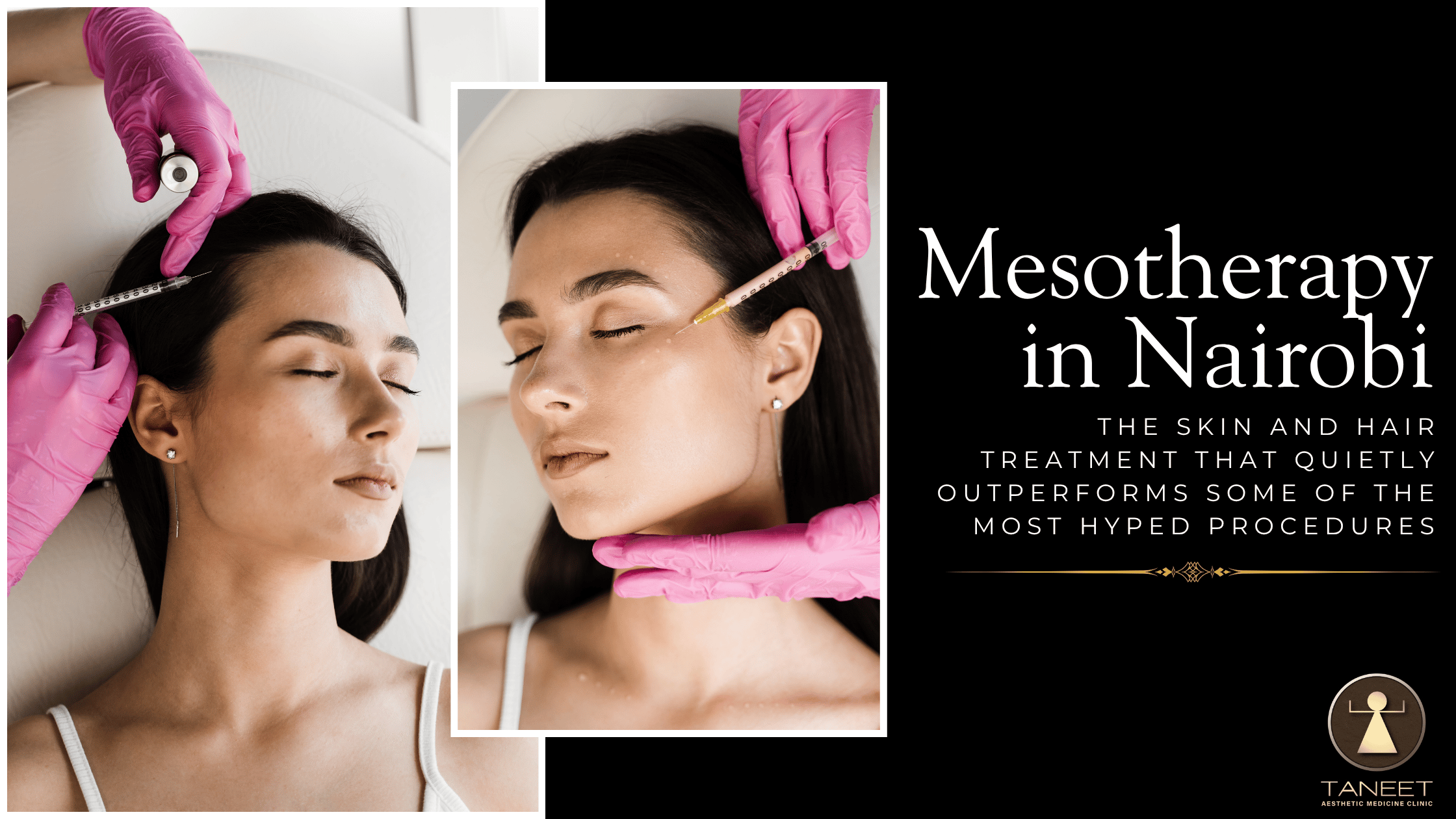
There is a treatment at Taneet that most patients discover only after they have already been through two or three other procedures.
Not because it is new, mesotherapy in Nairobi has been used clinically in Europe since the 1950s. Not because it is inferior, for certain concerns, it outperforms treatments that get significantly more attention. But because almost nobody in Nairobi is writing about it clearly, patients rarely think to ask for something they have not heard of.
This is that post.
Table of Contents
What is mesotherapy, actually?
Mesotherapy is a minimally invasive treatment that delivers a precisely formulated cocktail of active ingredients, vitamins, minerals, amino acids, hyaluronic acid, peptides, and other compounds, depending on the target concern, directly into the mesoderm: the middle layer of tissue beneath the skin’s surface, where blood vessels, lymphatics, and connective tissue converge.
The delivery mechanism is a series of very fine microinjections using a fine-gauge needle or an automated injector device. The needles do not penetrate deeply. The discomfort is mild; most patients describe it as a light scratching sensation. There is no general anaesthesia, no incisions, and no significant downtime.
What makes mesotherapy clinically interesting is precisely this delivery mechanism. The middle layer of tissue is where skin quality, fat distribution, and follicle health are governed, and it is the layer that topical products, however active, cannot reach. Mesotherapy bypasses the skin barrier entirely and deposits actives exactly where they need to be.
A 2022 review in the International Journal of Dermatology identified mesotherapy as clinically effective for both androgenetic alopecia (hair loss) and skin rejuvenation, with a favourable safety profile across skin types, including Fitzpatrick IV–VI.
Is mesotherapy the same as a chemical peel?
No. They are categorically different.
A chemical peel works on the surface; it applies an acid solution to the outermost layers of skin to exfoliate dead cells, stimulate cellular turnover, and, in the case of deeper peels, remodel the dermis. It works from the outside inward, and its effects are primarily surface-level (texture, tone, mild pigmentation).
Mesotherapy works from the inside. It delivers active ingredients to the tissue layer beneath the skin, where they stimulate collagen synthesis, improve microcirculation, boost cellular metabolism, and, in the case of scalp mesotherapy, supply the specific nutrients hair follicles need to function. The two treatments address different depths and different biological processes. They are not interchangeable, and in many protocols, they are complementary.
What does mesotherapy actually treat at Taneet?
Mesotherapy at Taneet is used across three primary applications.
Skin mesotherapy: hydration, glow, and collagen quality
For skin, the mesotherapy cocktail typically combines hyaluronic acid for deep hydration, vitamin C and B-complex for collagen stimulation and radiance, and a combination of antioxidants tailored to the patient’s skin profile.
The result, over a course of treatments, is significantly improved skin quality: better hydration retention, a visible improvement in dullness and uneven tone, and a gradual improvement in fine lines caused by dehydration and collagen degradation.
Skin mesotherapy is not the same as a skin booster (such as Profhilo); the delivery mechanism and formulation are distinct, but they share the goal of improving skin quality from within rather than adding volume or altering structure.
Related: Skin Boosters at Taneet Nairobi: What They Are and How They Differ from Fillers
Scalp mesotherapy for hair loss
Scalp mesotherapy targets the follicular microenvironment directly. The cocktail, which typically includes biotin (vitamin B7), zinc, cysteine, finasteride in some male protocols, and circulation-stimulating compounds, is injected into the scalp at the level of the follicular unit.
The treatment improves scalp microcirculation, delivers micronutrients that are often deficient in patients experiencing hair thinning, and creates a physiological environment more conducive to hair growth.
It is particularly effective as a complement to PRP therapy: PRP stimulates growth through growth factor signalling; mesotherapy ensures the follicular environment has the nutritional substrate to respond to those signals. Used together, they produce more complete outcomes than either delivers alone.
Related: Hair Loss in Nairobi: The Causes Women in Their 30s and 40s Don’t Expect
Mesolipo: fat reduction in localised areas
Mesolipo applies the mesotherapy principle to body fat reduction. A cocktail of phosphatidylcholine, deoxycholate, and other lipolytic agents is injected into subcutaneous fat deposits, most commonly the abdomen, inner thighs, and flanks, causing fat cell breakdown and lymphatic drainage.
Results are gradual and modest compared to cryolipolysis or EMS, but mesolipo is effective for precise contouring in small, stubborn areas where larger-scale devices are less targeted.
Compare: Cryolipolysis vs EMS vs MesoLipo: Which Body Treatment is Right for You in Nairobi?
Mesotherapy vs PRP for hair loss: which is better?
This is the question patients and practitioners debate, and the honest answer is that they do different things.
PRP uses your own blood’s concentrated growth factors, PDGF, TGF-β, and VEGF, to directly stimulate follicular regeneration and extend the growth cycle. Its mechanism is primarily signalling: it tells dormant follicles to activate. Evidence for PRP in androgenetic alopecia is strong and well-documented.
Mesotherapy supplies the micronutrient environment the follicle needs to respond. A follicle receiving growth factor signals from PRP but operating in a biotin-deficient or zinc-depleted environment will underperform. Mesotherapy addresses this.
For moderate to significant hair thinning, the clinical rationale for combining both is compelling. For mild thinning or as a maintenance treatment, mesotherapy alone is often appropriate and more cost-effective.
Is mesotherapy safe for dark skin in Nairobi?
Yes. Mesotherapy carries no specific risk for melanin-rich skin that other needle-based treatments do not. Because it does not involve heat, laser, or chemical exfoliation, it does not trigger the melanocyte activation that PIH-prone skin can experience with other procedures. It is suitable across all Fitzpatrick types and is one of the treatments where skin tone creates the fewest constraints.
The Skin of Colour Society classifies mesotherapy as a low-risk treatment for patients with high Fitzpatrick types, citing its non-thermal delivery mechanism and absence of inflammatory risk.
How many sessions do I need and how often?
A standard course for skin mesotherapy is three to six sessions, spaced two to three weeks apart, followed by maintenance every two to three months. Results are cumulative; most patients notice improved hydration and radiance after the second session, and the most significant change after the fourth.
For scalp mesotherapy: three to six sessions fortnightly, then monthly maintenance for the first year. After the first year, most patients move to quarterly maintenance.
For mesolipo: four to eight sessions every two weeks, with results visible by session four and final results assessed at eight weeks post-course.
Frequently asked questions
Does mesotherapy hurt?
Most patients describe mild discomfort, a light scratching or pricking sensation. A topical anaesthetic can be applied beforehand if you are particularly sensitive. There is no significant pain during or after the procedure.
Can I combine mesotherapy with other treatments at the same clinic?
Yes, and this is often recommended. Skin mesotherapy pairs well with peels (which work on the surface) and with skin boosters (which add structural hydration). Scalp mesotherapy pairs well with PRP. Your clinician will advise on timing and sequencing to avoid overlapping inflammatory windows.
Is there downtime after mesotherapy?
Minimal. Some patients experience mild redness and tiny injection marks for 24 to 48 hours. Most can return to normal activities immediately. You should avoid heavy exercise, swimming, and direct sun exposure for 24 hours post-treatment.
How does mesotherapy compare to skin boosters like Profhilo?
Profhilo is a high-concentration hyaluronic acid biostimulator injected at specific points to remodel the extracellular matrix. Mesotherapy delivers a broader cocktail of actives (including vitamins, minerals, and peptides) at multiple microinjection points. Profhilo is primarily a skin structure treatment. Mesotherapy is primarily a nutritional and cellular-function treatment. They complement rather than duplicate each other.
How long before I see results from mesotherapy?
Most patients notice improved skin hydration and a reduction in dullness within two weeks of the first skin mesotherapy session. For scalp mesotherapy and hair, reduced shedding is typically noticed at four to six weeks, with visible regrowth at the three-month mark.