
Publish Date: March 23, 2026
Service Link: Dermal Fillers at Taneet
You have been thinking about it for months.
Maybe longer.
Not because you want to look like someone else. Not because a trend told you to. But because there is a quiet gap between what you see in the mirror and what you imagine. A little more definition. A little more balance. Lips that look like yours, just… more.
And then the fear kicks in. What if it looks fake? What if everyone can tell? What if it goes wrong?
Those fears are valid. And they deserve honest answers.
This guide explains exactly what happens during a lip filler procedure, how recovery actually works, what makes the difference between “natural” and “obvious,” and how to find a practitioner who understands the difference.
Table of Contents
What Lip Fillers Are (And What They Are Not)
Lip fillers are injectable dermal fillers, almost always made from hyaluronic acid — a substance your body already produces naturally. The filler adds volume, defines shape, and enhances symmetry when injected into specific areas of the lip.
They are not permanent. Hyaluronic acid fillers are gradually metabolised by the body over 6–12 months, depending on the product used and individual metabolism. If you do not like the result, or if you want to return to your natural lip shape, the filler dissolves on its own over time, or can be dissolved almost immediately with an enzyme called hyaluronidase.
This reversibility is one of the most important safety features of modern lip fillers. You are not locked in. You are trying on a version of your lips, and you can always change your mind.
The Difference Between Natural and Obvious
Here is what nobody tells you: the most beautiful lip filler results are the ones no one notices.
The goal is not bigger lips. The goal is better lips. Lips that are hydrated, defined, and proportionate to your face. Lips that make people say “you look great” without ever guessing why.
The difference between natural and obvious comes down to three things:
Practitioner skill. An experienced injector understands facial anatomy in depth. They assess your lip anatomy, facial proportions, skin thickness, and natural lip ratio before placing a single drop of filler. They work in millimetres.
Product selection. Not all fillers are created equal. Softer, lower-viscosity fillers suit the lip body (the soft, fleshy part). Slightly firmer fillers can define the vermillion border (the lip line) and enhance the cupid’s bow. The right product in the right zone creates a natural-looking result. The wrong product creates a rigid, uniform look that screams “filler.”
Volume restraint. This is the big one. The most common cause of “obvious” lip fillers is too much product, too fast. A skilled practitioner will often recommend starting conservatively — typically 0.5–1ml — and adding more at a follow-up appointment if desired. Gradual enhancement always looks more natural than a dramatic single-session transformation.
| Clinical Note: At Taneet, lip consultations begin with a detailed assessment of your natural lip anatomy, including the ratio between your upper and lower lip, philtral column definition, and how your lips move when you speak and smile. This assessment guides every injection decision. |
What Happens During the Procedure
Before. A topical numbing cream is applied to the lips 15–20 minutes before the procedure. Most modern lip fillers also contain lidocaine (a local anesthetic) within the product itself, providing an added layer of comfort.
During. The practitioner injects the filler using either a fine needle or a blunt-tip cannula, depending on the technique and the areas being treated. The needle offers precision for border definition. The cannula reduces bruising risk for body volume. Injections are placed in specific anatomical zones: the vermillion border for definition, the lip body for volume, the philtral columns for structure, and the corners of the mouth if needed to lift a downturned appearance. The entire procedure takes 15–30 minutes.
After. Your lips will be slightly swollen. This is normal. Your practitioner will hand you a mirror. You will see an approximation of the final result, but the true shape emerges once the swelling settles.
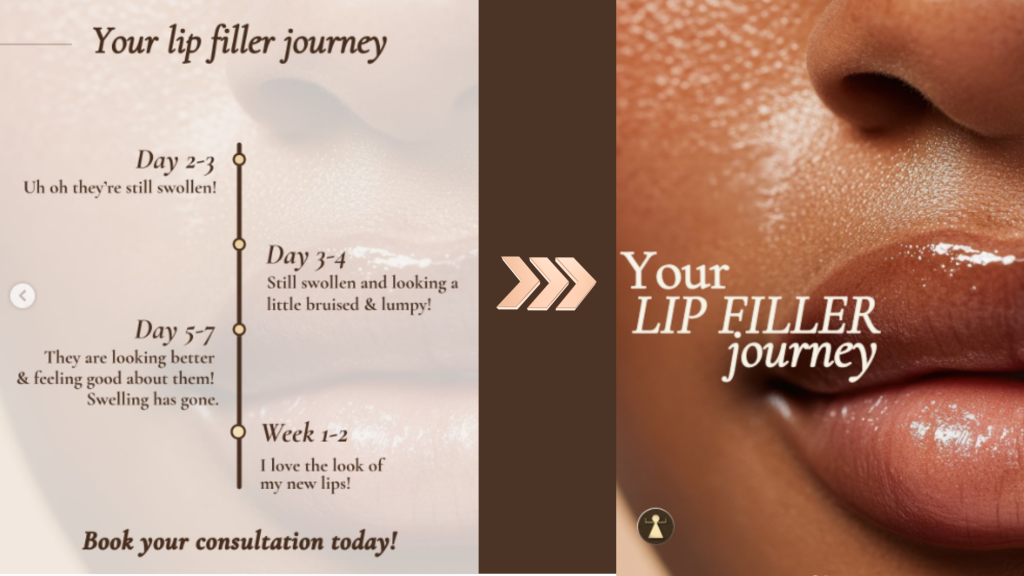
Recovery: What to Expect, Day by Day
Day 1. Swelling peaks. Your lips may feel tight, puffy, and slightly uneven. This is completely normal. Ice and avoiding salty foods help.
Days 2–3. Swelling begins to reduce. Minor bruising may appear, particularly if a needle was used. Arnica cream and gentle cold compresses speed resolution.
Days 4–7. The filler begins to integrate into the tissue. Swelling is mostly gone. You start to see the real shape and volume. This is when most clients fall in love with their result.
Week 2. The filler is fully settled. The final result is visible. If your practitioner recommended a review appointment, this is when it typically happens.
Months 6–12. Gradual, natural metabolisation of the filler. If you want to maintain the result, a top-up is scheduled before the filler fully dissolves.
Safety: The Questions You Should Be Asking
Lip fillers, when performed by qualified practitioners with genuine dermal filler products, are one of the safest aesthetic procedures available. But “when performed correctly” is the critical qualifier.
Ask your practitioner:
- What product are you using, and is it hyaluronic acid-based? Legitimate HA fillers are dissolvable. Non-HA fillers carry a higher risk.
- Do you carry hyaluronidase in the clinic? This enzyme dissolves filler in an emergency. Any practitioner who injects lip filler should have it on hand.
- How many lip filler procedures have you performed? Experience matters. Lip anatomy is complex and varies significantly between individuals.
- Can I see before-and-after photographs of your previous work? Specifically, look for results that match the style you want.
Lip Fillers on Melanin-Rich Skin
A note that matters for the Nairobi context: melanin-rich skin is more prone to keloid scarring and post-inflammatory hyperpigmentation. While lip filler injection sites are tiny and heal quickly, always inform your practitioner if you have a history of keloid formation. For a deeper look at how different skin tones respond to injectable treatments, the American Academy of Dermatology offers guidance on filler safety across skin types.
Can Lip Fillers Be Combined With Other Treatments?
Yes. Lip fillers are part of a broader facial aesthetics toolkit and often complement other treatments:
Botox + Lip Fillers. A “lip flip” uses a small amount of Botox to relax the muscle above the upper lip, allowing it to roll outward slightly. Combined with filler, this creates enhanced upper lip volume and visibility without additional product.
PRP + Lip Fillers. PRP injected around the lip area can improve skin quality, hydration, and fine vertical lip lines (smoker’s lines), creating a smoother canvas for filler results.
PureHydro Facial + Lip Fillers. Optimal skin hydration before your filler appointment ensures the best canvas and can enhance the glow that well-done fillers naturally produce.
Frequently Asked Questions
Q: Do lip fillers hurt?
Topical numbing cream and lidocaine within the filler make the procedure very manageable. Most clients describe a mild pressure or pinching sensation, not pain.
Q: Will my lips look fake?
Not with a skilled injector who prioritises proportion and restraint. Natural results come from understanding your anatomy, not just filling volume.
Q: How long do lip fillers last?
Typically 6–12 months, depending on the product used and your individual metabolism. Lip fillers tend to metabolise faster than fillers in other areas because the lips are highly vascular and constantly in motion.
Q: What if I don’t like the result?
Hyaluronic acid fillers can be dissolved with hyaluronidase, an enzyme that breaks down the filler within 24–48 hours. This is one of the strongest safety features of HA fillers.
Q: Can lip fillers migrate?
With proper injection technique and appropriate product selection, migration is rare. It is more commonly associated with excessive volume or incorrect product placement. Choose your practitioner carefully.
The Permission You Already Have
Here is the truth that the beauty industry rarely says out loud:
You do not need to justify wanting fuller lips.
You do not need a dramatic reason. You do not need to have “thin” lips by anyone’s standard. You do not need to explain yourself to anyone.
If a subtle enhancement would make you feel more like you, that is reason enough.
The best lip filler results are not about conforming to a trend. They are about alignment. Between what you see and what you feel. Between the outside and the inside.
That alignment is worth pursuing.
→ Book your lip filler consultation at Taneet. Honest guidance. Beautiful results. Your lips, elevated.