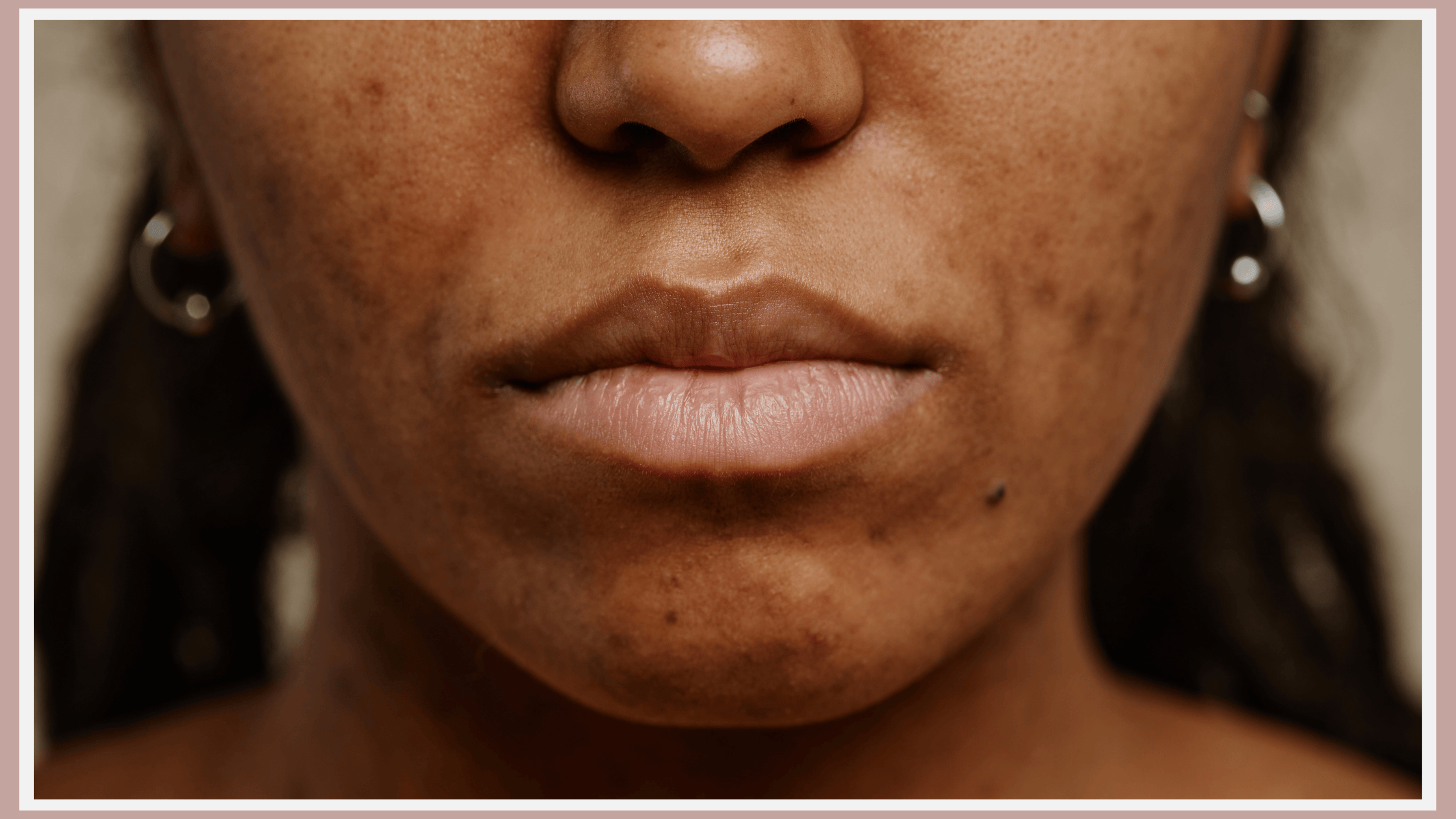
You have tried the vitamin C. The niacinamide. The alpha arbutin. The tranexamic acid serum costs more than it should.
Every time a dark spot begins to fade, something brings it straight back. A breakout. A day in Nairobi’s midday sun. A week of poor sleep and cortisol. A scratch that healed in three days but left a mark that is still there three months later.
If this loop is familiar, you are not doing skincare wrong. You are facing a biological mechanism in melanin-rich skin that most skincare products are not designed to address, and that most online content does not accurately explain.
Here is what is actually happening. And what can be done about it.
Table of Contents
What causes dark spots, and why is melanin-rich skin uniquely affected
Melanin is produced by cells called melanocytes, and its primary role is protection. It absorbs ultraviolet radiation and converts it to heat, shielding deeper skin layers from damage. This is why darker skin ages more slowly and has a lower baseline risk of skin cancers.
But melanocytes do not only respond to UV. They also respond to inflammation.
When melanin-rich skin experiences irritation, a breakout, friction, a reaction to a product, or even aggressive exfoliation, the melanocytes interpret that inflammation as a threat and produce excess melanin at the site. The breakout clears. The wound heals. The melanin remains.
This is called post-inflammatory hyperpigmentation, or PIH. It is not a flaw in darker skin. It is an evolutionary protective mechanism, one that evolved as additional photoprotection but, in practical terms, means that any insult to the skin carries a disproportionate risk of leaving a lasting mark.
The Journal of Clinical and Aesthetic Dermatology has published extensively on PIH in Fitzpatrick types IV–VI, consistently finding that treatment protocols designed for lighter skin fail or worsen outcomes in melanin-rich patients, underscoring why skin-type-specific clinical care matters.
What is the difference between melasma and post-inflammatory hyperpigmentation?
This distinction is important because the two conditions look similar but respond to very different treatments.
Inflammation, a breakout, a wound, or a procedure can cause PIH. It is localised to the site of inflammation, tends to appear at any age, and can affect anyone with sufficient melanin in their skin. It responds well to peels and, in resistant cases, to laser.
Melasma is driven by hormonal activity, oestrogen, progesterone, and UV exposure acting together. It is typically bilateral (both cheeks, forehead, upper lip), becomes more pronounced during pregnancy and hormonal contraceptive use, and is significantly more difficult to treat because the driver is systemic rather than local.
Standard peels can temporarily fade melasma, but often trigger rebound. It requires a more managed, less aggressive protocol, often combined with topical maintenance and sometimes hormonal assessment.
Treating both as “dark spots” with the same peel will produce poor results for one or both. This is why clinical assessment precedes every treatment plan at Taneet; the diagnosis determines the protocol.
Why vitamin C, niacinamide, and other serums are not enough
These ingredients are legitimate and do work, within specific limits.
Vitamin C, kojic acid, niacinamide, and azelaic acid all inhibit tyrosinase, the enzyme that drives melanin production. They provide antioxidant protection and help fade superficial pigmentation gradually. For very mild, recent pigmentation in otherwise stable skin, a well-formulated routine can produce visible improvement.
The problem is penetration depth. Cosmetic products are regulated to remain at or near the skin surface. Deep pigment deposits, the kind that form after significant inflammation, or that have been accumulating for years, sit below where these actives can reach at over-the-counter concentrations.
There is also the trigger problem. If your dark spots are driven by hormonal fluctuations, ongoing breakouts, or habits that repeatedly inflame your skin (such as certain waxing methods, harsh exfoliants, or low-SPF exposure), no topical product addresses the root cause. It is like mopping the floor with the tap still running.
Can a chemical peel make dark spots worse on dark skin?
This is one of the most common concerns Kenyan patients bring to the clinic, and it is a valid one.
A poorly selected peel, one designed for lighter Fitzpatrick types, applied at full strength without adjustment, by a clinician who has not been trained in melanin-rich skin, can absolutely cause PIH of its own. This happens when the peel induces more inflammation than the skin can manage without triggering excess melanin production.
A correctly selected peel, calibrated for your Fitzpatrick type, applied in a controlled sequence with appropriate pre-treatment preparation, does the opposite: it suppresses melanin activity while exfoliating the pigment that has already formed. The key variables are peel formulation, concentration, frequency, and the clinician’s understanding of your skin.
See the Mayo Clinic’s clinical overview of chemical peels for general procedure standards. Taneet adapts these within a melanin-specific framework for every patient.
Further reading: A Complete Guide to Chemical Peels at Taneet, Nairobi
Is laser safe for dark skin in Nairobi?
This question has a clearer answer in 2026 than it did ten years ago: yes, with the right device.
Older laser platforms, Q-switched Nd: YAG at certain settings, and some IPL configurations carried a real risk of permanent hyperpigmentation or hypopigmentation (loss of colour) in darker skin tones. Those risks were not theoretical; they were documented in the clinical literature and shaped understandable wariness among patients of colour toward laser treatment.
The Aerolase Neo Elite, used at Taneet, is a 650-microsecond Nd: YAG laser with a pulse duration specifically engineered to bypass the melanin-absorption risk that caused problems with earlier systems. Clinical studies have consistently demonstrated its safety profile across Fitzpatrick types V and VI.
It targets pigment at specific depths without collateral thermal damage to surrounding tissue. The melanin-specific risk that made earlier lasers dangerous on darker skin is addressed by design, not by workaround.
The American Academy of Dermatology’s guidance on hyperpigmentation recommends that patients of colour verify that their clinic uses devices with documented safety data for their specific Fitzpatrick type before undertaking any laser treatment.
How many treatment sessions will I actually need?
This depends on three things: the depth of your pigmentation, what is driving it, and whether the trigger is still active.
For mild-to-moderate PIH with no ongoing trigger: a course of four to six graduated peels typically produces significant improvement, with maintenance peels every six to eight weeks thereafter. Some patients also benefit from a targeted Aerolase session to address deeper or more resistant deposits after the peel course.
For melasma, treatment is longer, more managed, and often ongoing. It typically involves a combination of peels, topical agents, and strict sun protection. The goal is control and maintenance rather than elimination, because the hormonal driver remains active.
For either condition: SPF 50, reapplied every two hours when outdoors, is non-negotiable. Nairobi’s altitude puts you closer to the sun than you might expect from the temperature; the UV index regularly reaches 8 to 10, even on overcast days. Treated skin that is re-exposed without protection will re-pigment faster than untreated skin.
Frequently asked questions
Why do my dark spots come back every time they fade?
Most recurrences are caused by ongoing triggers, recurring breakouts, hormonal fluctuations, inadequate sun protection, or repeated friction. Topical treatments can fade existing pigmentation, but cannot prevent new pigmentation from forming if the trigger is still active. Clinical treatment addresses both the existing pigmentation and the underlying mechanism driving it.
What is the difference between a dark spot and a scar?
A dark spot (PIH) is a discolouration caused by excess melanin in the skin. It has no texture difference from surrounding skin and responds to targeted treatment. A scar involves a change in skin structure (often raised or depressed) and requires different treatment approaches, such as microneedling or Morpheus8.
Can I use brightening products while undergoing clinical treatment?
This depends on the specific products and treatment protocol. Some actives, particularly retinoids and exfoliating acids, should be paused around peel dates to avoid over-exfoliation. Your clinician will advise on what to continue, pause, and resume. Vitamin C and SPF are almost always maintained throughout.
Is it safe to treat dark spots during pregnancy?
Most clinical treatments for hyperpigmentation, including peels with certain acids and any laser treatment, are not recommended during pregnancy. Safe alternatives do exist, and your clinician will advise accordingly. Postpartum treatment is highly effective once hormones stabilise.
How long will it take to see results from treatment?
Most patients notice improved skin evenness within two to three weeks of the first peel. Significant pigmentation reduction is typically visible by the fourth session. Deeper or hormonally-driven pigmentation takes longer. Your treatment plan will include realistic timelines.